Monday, August 18, 2008

Home

I have dedicated a few months to living nomadically---I just returned from a journey to India and will leave for Europe in September to work on a project . I carry everything I need in my backpack; it's purple, ancient, and
weighs 10 kg .The items that it contains are carefully selected for practical or sentimental reasons.
Contents:
-Money/Passport/airline ticket/travellers cheques
-Tea makings: stainless steel cup, small heating element, tea bags
-Candle and matchsticks
-A small item from each person who is close to my heart.
-Journal and drawing material
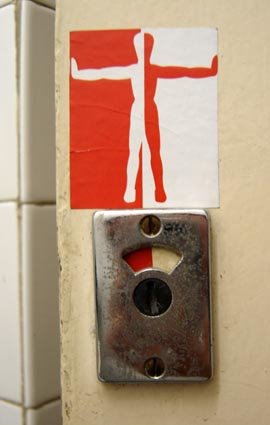
-Anyman stickers (see website )
-Yoga mat
-Laptop
-Maps
-Bed sheet and pillowcase
-Needle and thread
-One pack of sugar free chewing gum
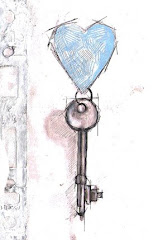
-The key to your apartment (you know who you are)
-Clothes: one change of underwear, one pair of long pants (with secret pockets), my purple Punjabi, sandals,green scarf
-Toiletries and supplements: face wash, dental floss,body oil, lice comb, sunscreen(factor 40), yellow face sponge ,baby shampoo,Neroli and Tea Tree essential oil, mosquito repellent, multi-vitamin and calcium, toothpaste and toothbrush, contraceptive pill.
-Sony Digital camera and sound recorder

I am documenting my journey and the daily routines that give me a sense
of being at home in whatever place I am in.

I am currently researching the idea of ‘home’ . I am asking people to describe (using words or images) ,what home means to them. What generates that feeling of security and belonging that makes you feel at home?
Is it the place you live, is it a person, a memory ,a material possession or a ritual/routine.
Is home a place?--if so then where and why
Is it a person(s)?--who and why
Is it a special possession that you carry with you?
Is it a combination of the above or none of the above?
What activities/routines make you feel at home?
What sounds ,smells,tastes,textures and sights do you associate with home?


Tuesday, June 03, 2008

Outside_In


"The pleasure we derive from journeys is perhaps dependent more on the mindset
with which we travel than on the destination we travel to"
-Alain De Bouton
I'm preparing for a journey to India. I'm going to do a yoga teachers training course in Rishikesh, a small town in the North where the streets are paved with Holy-men and pseudo swami's (those who do it for fun and profit and who have been known to wear Nike trainers beneath their pious robes).

The 'Caucasian-Western-(bottle)- blond- female- tourist- on- a- quest-to- become- one- with- her- inner- dolphin', is a stereotype that chafes my soul like a pair of cheap sneakers.

I've been thinking of my body as my mobile home--the portable , vessel that contains and occupies space. My interior is furnished with multiple layers of thoughts, experiences and perceptions that make me what I am.This is me deliberately extracting my body from its familiar ,everyday context ,an action which I have romanticised into a pilgrimage . Journeys like this sound exotic and mystical, and they probably are to some extent ,but they are also gritty and grimy and punctuated with 'beam-me-up-scotty' moments, when I wish I was back on the couch at home watching life through the filter of the Travel Channel.

Preparing for this journey involves more than dusting off my backpack and pumping my veins full of vaccinations; it involves mentally and spiritually opening up to the beauty and the ugliness of India, of the unknown ...and of myself.

Most travellers feel compelled to document their journeys. I aim to formalise my documentation process into a project , a daily ritual whereby certain aspects of the journey are systematically recorded and catalogued to create an archive of index cards with text and drawings. I have designed a series of cards , one per day , for the purposes of illustration and documentation. The idea is to use each card to represent a 24-hour period so that when they are lined up at the end of the journey they will form a timeline of memory and association--creating a visual archive that bears testimony to one person's experience in a specific time and space.
The cards are printed on 200gm white cardboard . Their dimensions have been calculated to measure 6 by 4 inches (6 multiplied by 4 = 24 (the number of hours in a day)
The front is a blank space for illustration . All drawings will be based on a significant place or experience that defined the day.
The back is designed in the style of an official form where the following data will be logged:
  • Day no.(of journey)
  • Date
  • Keyword(the day described in one word)
  • Location (country, city, place)
  • No. of steps walked per day (counted using a pedometer),
  • Dreams recalled (first thing on waking)
  • General comments/insights/experiences

I will also be mapping my journey on the Travellerspoint blogsite.

Tuesday, March 25, 2008

Wish Collecting Project


What are your wishes ? Why did you wish them?

The Wish collecting project aims to create an archive that maps the dreams and desires of a cross section of contemporary society. It gives the public a voice by encouraging people to clarify and express their visions/hopes for the future. The project is expanding into several formats with over five hundred wishes collected so far. In February this year the Dutch -intiated Cascoland project (www.cascoland.com) ,woke up my sleepy hometown of Durban. The idea was to initiate projects that intervene in public space . I am interested in interrupting the robotic daily routines of commuters. Passers by are invited to write down their wish and hold it up in a portrait photograph which is subsequently printed out and given to them. The intention is to encourage the public to remember, re-enforce and reflect on the the actions or events which they need to manifest in their lives. At first I had a moral dilemma in getting people to publicly declare their wishes, aren't they supposed to remain secret? The solution is to create a wish list: wishes based on genuine need are written onto a list with the aim of finding ways of granting them (either in a personal capacity or by approaching people who have the necessary resources.) This would ideally encourage a culture of reciprocity where you would make a wish but also be able to read the wishes of others which it may be within your power to help fulfill. It would make people cut through their superficial desires to consider what their genuine needs are . The Cascoland project was located along a route between an informal housing settlement called Little Cato Manor, to the Durban Harbour. The route transects a variety of cultural and economic sectors of society. By collecting wishes from people along this route I was able to compare those of street children and the homeless with those of the affluent and educated. In this way wish collection can be used as an effective research tool. There have been two portable wish collection kiosks constructed which will be moved to different areas of the city and left in public spaces to enable people to make and deposit a wish anonymously. Each wisher will be given a receipt which they must retain until their wish comes true.

Friday, May 25, 2007

From Bedroom to Birthplace


I recently located the place where I was born. It used to be called Durban Mother's Hospital now it is the Salvation Army . The building has been turned into a hostel /boarding house and is run by a Colonal who promised to look up my birth records in exchange for Kentucky Fried Chicken. The birth records are kept in huge books in a broom cupboard under the stairs. I was born at 4.30 am in bed no. 271 on the 9/03/1978, in a surgery that is now home to a family of five.
The project involved a walk, with my mother,
between the place I call ‘Home’ and the point at which I emerged into the world. The walk traces a path between the present and the past,

The journey was documented in the following ways:

-Collecting found objects from the immediate environment.

-Counting steps using a pedometer.

-Carrying a GPS device which logs the distance and speed we were moving at any point in the journey

-Labeling the route with stickers. The stickers advertise a web address on which people can find out more about the project.

-Using Google Earth software I created a place mark for each of the objects which allowed me to note their exact location in terms of lines of longitude and latitude.

- Photographs were taken along the route.

Every found object is labeled with the number of steps taken to that point. The object is photographed in its original location.

Each object holds a specific memory, serving as a reminder of place and experience. These objects contextualize the walk by signifying the nature of the space and time and culture in which the journey is located.

Wednesday, April 25, 2007

You are (w)here !?

I've been lost in virtual space :if I'm not stumbling through the various scattered thoughts in my mind, I'm trawling through the various scattered thoughts on the Internet. Surfing like a pro without getting my feet wet.

Of all the possible topics for a thesis, of all the possible combinations of concepts and words, I am in the process of filtering, focusing and distilling. Space, Time, Maps, Psycho geography, archiving daily lived experience ....these have become the catchphrases of my existence. My head is full of french social theorists: Guy Debord, Henri Lefebvre, Michel Foucault. I fall asleep with them every night gurgling through the digestive tract of my consciousness. Despite what may be said about french men, none of these fellows are really good in bed. Lefebvre's socially produced space bounce off Debord's Psycho geography and ricochet against Foucalt's theories on Power and hetertopias. They all speak about similar notions: about space, place and site being the product of the people who occupy and navigate them; about space existing in time and therefore in history and memory. The point of departure when considering space must surely be the human body-as a vessel which both contains and occupies space and must mediate between internal psychic/mental spaces and external spaces. Bodies interact with other bodies, shaping environments through their thoughts and (inter)actions.

I am interested in exploring the manner in which individual bodies move through space during the course of their daily routine. I track my routes with GPS, I collect objects (one per day)which remind me of my presence in a specific site, I carry a small journal(one per day) around with me at all times to document my thoughts and experiences.The collecting and documenting of personal lived experience is an attempt to locate my body in time and space. This is a one year (365day) project begun on the first of January 2007. At the end of the project there will be an object and a journal for each day of the year---a personal record of one person's routine existence in linear time and gridded space.

My art uses maps--cut up, stripped of place names, stitched into and re-presented as 3d cubes. This is my attempt to interrogate the separation between perceived space (material space) and conceived space which interprets and transcribes physical space into a 2dimensional format. Space is organic, places are always changing according to the movement and interactions that occur between the people who occupy those spaces. Maps lock place into a specific, immutable time frame---they can never be completely accurate yet we use them to make sense of the spaces we occupy. Maps are symbols of power: they influence the manner in which a space is navigated, perceived and remembered.

Look around Durban and see how the act of changing the city's street names is an attempt to erase and rewrite the history of a place. There are going to be lots of spelling errors :New street signs labour beneath the bulk of un- pronouncible double-barrel surnames....

...But that's another issue. For now I'll plunge back into the surf a terrain without street names
theories on spatial practice bounce off Foucault theories of space and power which in turn ricochet against (but seething with social theorists). The waves are always great in the ocean of Google.

Wednesday, August 09, 2006

Whitespace

Nature vs. Nurture. How much of who you are is embedded into your genetic coding? How much of who you are has been moulded by your environment ? This project is an experiment ! .Blank white squares of artist canvas are left in various spaces. Initially the squares are identicle but gradually each will develop distintive markings reflecting the nature of the environment in which it is located .The intention is for the squares to gradually become integrated into the environment. If you see one on the pavement walk over it , not around it. If you see one under a tree , sit on it, eat your lunch off it! if there is one in the middle of the road drive over it. Just please leave them where they are.

The concept of whitespace
refers to the empty space that is so lacking in the media-driven, capitalist society that we call reality. We have reached a state of information overload! Every available space (virtual space included) is set aside to communicate a message . That message may be in the form of a traffic signal, a street name, a radio jingle or a flyer thrust through your window at a stop street. This project is an attempt to reclaim areas of whitespace while simultaneously documenting the impossibility of occupying space without transforming and being transformed by it.

Friday, May 12, 2006

Who is Anyman ?


Anyman represents the individual in society. It is a symbol, created to encourage you to consider the implications of how you occupy space and how the space you occupy shapes your identity. Every space has a temporal aspect : it exists in time and has a history attached to it. Anything (and Anyman) entering that space catalyses a reaction and becomes a part of its history. Anyman aims to bring awareness to the fact that the environments we inhabit are designed and controlled by people in positions of power who reserve the right to manipulate space and subsequently to influence the ontological stance of the individuals who inhabit that space.

When did you last see a view free from any man made structure or intervention? In this 24-hour a day global village the total human population is approximately 6,000,129,811. Space and time have become politiscized, commercialised and regulated commodities. Urban spaces in particular are geared toward promoting consumption.The population is increasingly inundated with sensory data. You are perpetually receiving ,processing and interpreting information. This information moulds your identity. Society is structured on the concept of the individual, but convenience culture has made conformity seem more compelling than individuality. Every individual can be percieved of as s a brand communicating a certain ideology through interaction with its environment. Every brand needs to retain its integrity.Every brand needs to make its voice heard against the background noise. This doesn't mean shouting louder than anybody else it means saying something different and saying it with conviction. Anyman hopes to remind you of that.

Coca-colonised culture is saturated with brands competing for your attention in both public and 'private' spaces. The Nike swoosh advises you to "Just do It", the golden arches of Macdonalds sell happiness in the form of a burger and a plastic toy, Madonna has cornered the market as a sex diva and an author of childrens fables. As a consumer you are able to purchase everything from chewing gum to longevity. Every available surface is a target for branding : logos have been lazered onto the yolks of eggs (while still in the shell), humans have been branded by celebrity worship, Google has become a verb and Pepsi has proposed projecting its logo onto the surface of the moon. The proliferation of advertised brands is apparent even in the pristine suburbs where the walls of houses are branded with the names of armed response units and "For Sale signs.

Anyman has infiltrated this cacophany of branded visual data. It is an ironic brand employing guerilla advertising techniques to draw attention to the social implications of the mass media industry ie: using the medium to subvert itself.

The intention is to make the Anyman logo as prominent and ubiquitous as possible. Look out for it on street pole ads, in the classified section of newspapers, on road signs, stickers, stencils and flyers and superimposed over existing advertisments . If you spot him please take a photo and contact me.